Easy Side Hustles From Home to Earn $1,000+ Per Month (2026)
- 05 Jan, 2026
In this article
- 1. What Makes a Side Hustle Actually “Easy”?
- 2. The Income Timeline Reality Check
- 3. 1. Freelance Writing: The Beginner-Friendly Classic
- 4. 2. Virtual Assistant Services: Leverage Skills You Already Have
- 5. 3. Online Tutoring: Turn Knowledge Into Income
- 6. 4. Selling Digital Products: Build Once, Sell Forever
- 7. 5. Proofreading and Editing: The Detail-Oriented Side Hustle
- 8. 6. Social Media Management: Turn Scrolling Into Income
- 9. 7. Bookkeeping: Boring Work That Pays Consistently
- 10. 8. Course Creation: Package Your Expertise
- 11. 9. Graphic Design (Templates & Client Work)
- 12. 10. Email Newsletter Consulting
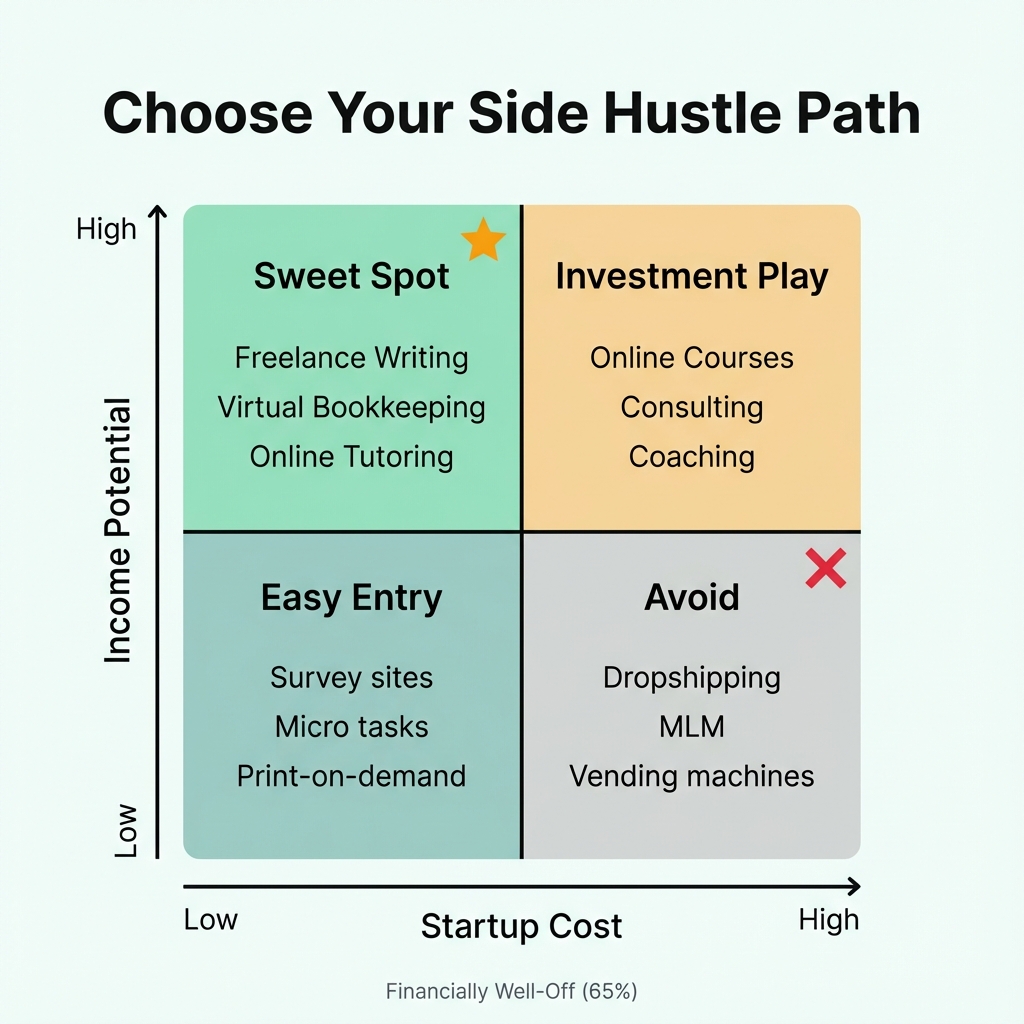
- 13. How to Choose the Right Side Hustle
- 14. The Boring Truth About Side Hustles That Actually Work
- 15. What to Do With Your Side Hustle Income
- 16. Your Next Move
You’ve got your 9-5 handled. Bills get paid. But there’s that ceiling—your salary only goes up 3% a year while your goals are growing way faster.
I get it. I started $16K in debt on a $45K salary. Budgeting helped. Cutting lattes? Barely moved the needle. What actually changed things was building income outside my job.
Here’s the reality: the best side hustles aren’t get-rich-quick schemes. They’re realistic paths to an extra $1,000-5,000 per month that you can run from your couch while keeping your day job. Some take a few weeks to generate income. Others take months. But all of them scale beyond just trading your hours for dollars.
This is your roadmap—real numbers, realistic timelines, and which side hustles actually work in 2026.
What Makes a Side Hustle Actually “Easy”?
Let’s define terms first, because “easy” is doing a lot of work in that title.
A side hustle is easy when it checks these boxes:
- Low barrier to entry - You can start without certifications, expensive equipment, or a trust fund
- Flexible hours - You can do it nights and weekends around a full-time job
- Fast to first dollar - You’re earning within weeks, not months
- Scales beyond your time - Eventually you’re not just trading hours for cash
What’s NOT easy:
- Building a YouTube channel that monetizes (takes 12+ months)
- Creating a SaaS product (requires coding skills or capital)
- Dropshipping (oversaturated and requires ad spend)
- Multi-level marketing (just… no)
The sweet spot? Skills you already have + platforms that connect you to buyers + consistent effort over 3-6 months.
Let’s break down what actually works.
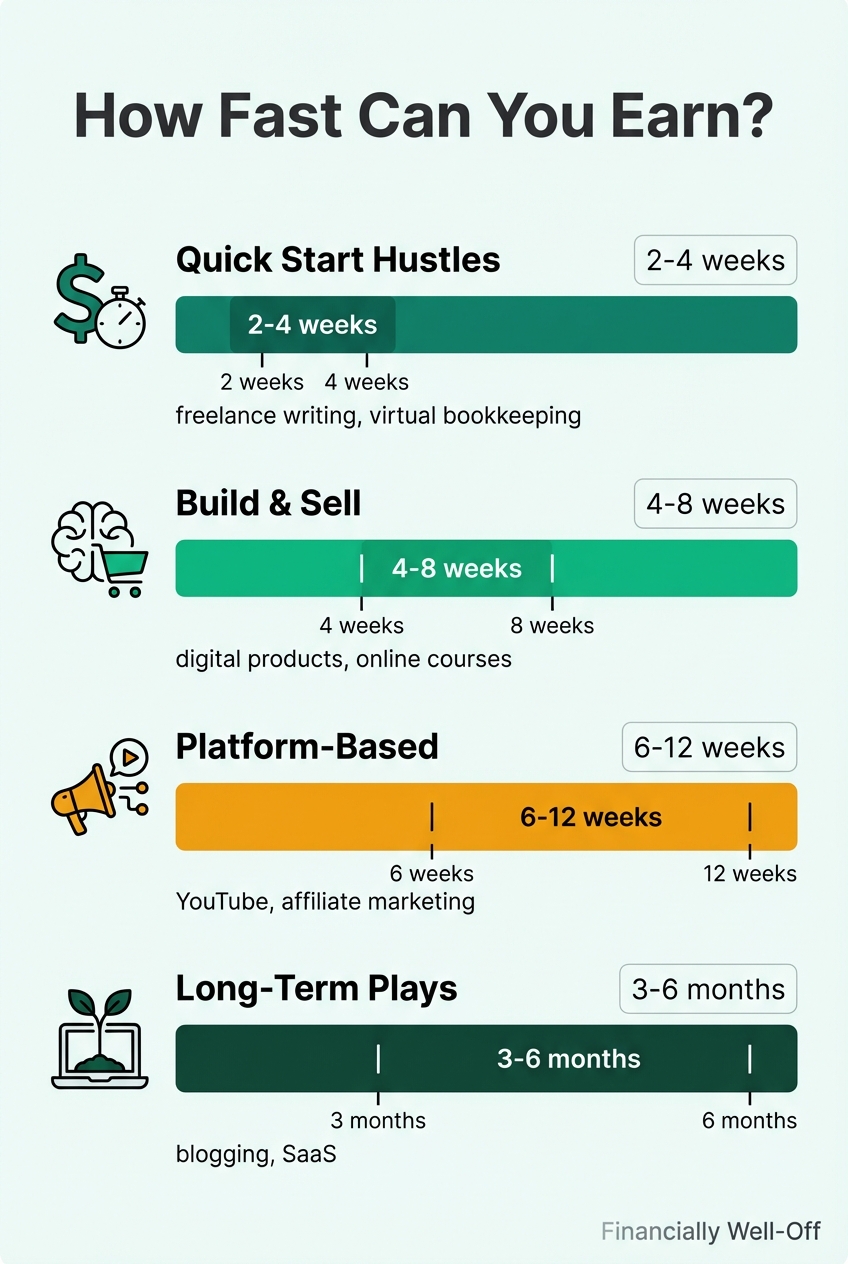
The Income Timeline Reality Check
Before we dive into specific hustles, here’s what income progression actually looks like:
| Timeline | Realistic Income Range | What’s Happening |
|---|---|---|
| Month 1 | $0-300 | Setup, learning curve, first attempts |
| Months 2-3 | $300-1,000 | First clients/customers, refining approach |
| Months 4-6 | $1,000-2,500 | Momentum building, repeat business |
| Months 7-12 | $2,000-5,000+ | Systems in place, possible passive income |
| Year 2+ | $3,000-8,000+ | Established, scaling, or fully passive |
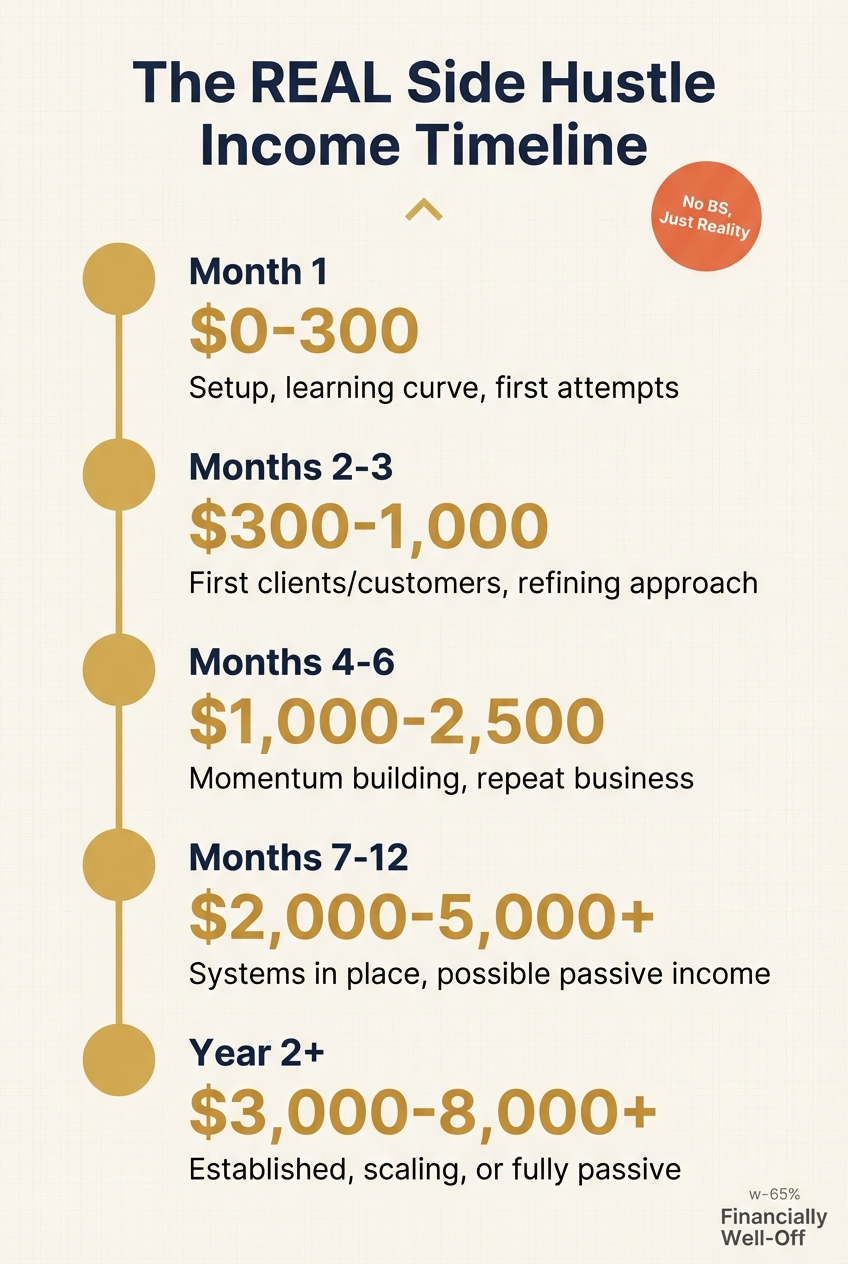
Key insight: Anyone promising “$10K in your first month!” is lying. Real income builds over time. The goal is to hit $1,000/month by month 3-4, then scale from there.
Now let’s get into the actual side hustles.
1. Freelance Writing: The Beginner-Friendly Classic
What it is: Writing blog posts, articles, website copy, or email sequences for businesses.
Income potential: $1,500-5,000/month (realistic after 3-6 months)
Startup costs: $0 (maybe $15/month for Grammarly Premium)
Time to first dollar: 2-4 weeks
Why it works in 2026: AI hasn’t killed writing—it’s just changed what clients value. ChatGPT can generate mediocre content fast, but clients quickly learned that “mediocre” doesn’t rank on Google or convert readers. What they actually pay for now: expertise, strategic thinking, and writing that sounds human.
The realistic math:
- Beginner rate: $0.10-0.15 per word
- A 1,500-word article at $0.10/word = $150
- Write 3 articles per week = $450/week or $1,800/month
- After 6 months at $0.20/word = $3,600/month for the same output
Who this works for:
- You can write clearly (if you’re reading this, you probably can)
- You have expertise in any niche (tech, finance, health, marketing)
- You’re willing to pitch, get rejected, and keep going
How to start:
- Pick 2-3 niches you can write about (use your job experience)
- Write 2-3 sample articles and publish on Medium or LinkedIn
- Create a basic portfolio (Notion page works fine)
- Apply to jobs on ProBlogger, Contently, or Upwork
- Send cold pitches to businesses in your niche
The catch: Month 1 is mostly setup and rejection. You’ll apply to 30+ jobs before landing your first client. But once you have 2-3 regular clients, the income becomes predictable.
Get the complete freelance writing guide →
2. Virtual Assistant Services: Leverage Skills You Already Have
What it is: Handling administrative tasks, email management, scheduling, social media, or customer service for busy entrepreneurs and small businesses.
Income potential: $1,500-4,000/month
Startup costs: $0-50 (basic software subscriptions)
Time to first dollar: 1-3 weeks
Why it’s actually easy: You’re not learning a new skill—you’re packaging skills you already use at your day job. Can you manage a calendar, respond to emails, or schedule social posts? Congrats, you’re qualified.
The realistic math:
- Beginner hourly rate: $20-30/hour
- 5 hours per week per client × 4 clients = 20 hours/week
- 20 hours × $25/hour × 4 weeks = $2,000/month
What clients actually need help with:
- Email inbox management (triage, respond, filter)
- Calendar scheduling and meeting coordination
- Social media posting and basic engagement
- Data entry and spreadsheet organization
- Customer service and client communication
- Basic graphic design (Canva templates)
- Research and report compilation
Who this works for:
- Detail-oriented people who like organizing systems
- Anyone who’s good at email and project management
- People who can anticipate needs before being asked
How to start:
- List 5-7 tasks you do at your job that businesses need
- Create profiles on Belay, Time Etc, or Upwork
- Network in Facebook groups for VAs
- Offer a “trial week” at a discount to land first client
- Ask for testimonials immediately
The scaling path: Start with basic admin tasks. Specialize in a niche (real estate VAs, podcast VAs, e-commerce VAs) to charge premium rates. Eventually hire other VAs and become an agency.
3. Online Tutoring: Turn Knowledge Into Income
What it is: Teaching subjects you know well via video calls (math, science, languages, test prep, music, coding).
Income potential: $1,200-3,500/month
Startup costs: $0 (platforms handle payment)
Time to first dollar: 1-2 weeks
Why it works: Parents will always pay for their kids’ education. Professionals will pay to upskill. And Zoom made tutoring from home completely normal.
The realistic math:
- Average rate: $25-60/hour depending on subject
- 10 hours per week at $35/hour = $350/week
- $350 × 4 weeks = $1,400/month
High-paying subjects (2026):
- SAT/ACT test prep: $40-80/hour
- Coding/programming: $50-100/hour
- English as a second language: $20-50/hour
- Math (high school/college): $30-60/hour
- Music lessons: $30-70/hour
Who this works for:
- Anyone with a degree or expertise in a subject
- Former teachers or current educators
- Subject matter experts willing to teach basics
Platforms to start:
- Wyzant - Set your own rates, keep 75% after fees
- Tutor.com - Apply to teach specific subjects
- Preply - Language tutoring focused
- Outschool - Teach group classes to kids
- Local Facebook groups - Charge full rate, no platform fees
The catch: Income is directly tied to hours worked. To scale, you’d need to teach group classes or create recorded courses.
4. Selling Digital Products: Build Once, Sell Forever
What it is: Creating templates, guides, spreadsheets, courses, or printables that people buy and download.
Income potential: $500-5,000/month (highly variable)
Startup costs: $0-100 (design tools, hosting)
Time to first dollar: 4-8 weeks (slow start, but compounds)
Why it’s the ultimate side hustle: You build it once. It sells while you sleep. No client management. No ongoing work after launch. Pure passive income if it works.
What actually sells:
- Notion templates (productivity, budgeting, project management): $10-50 each
- Spreadsheet templates (budget trackers, business dashboards): $15-40
- Canva templates (social media, presentations, resumes): $5-30
- Guides/ebooks (how-to content in your niche): $20-100
- Checklists/workbooks (business launch, home buying): $10-30
The realistic math:
- Create a $20 Notion budget template
- Sell 10 per week = $200/week or $800/month
- Add 3 more products = potential $2,400-3,200/month
Where to sell:
- Gumroad - Easy setup, 10% fee, clean checkout
- Etsy - Great for printables and templates
- Creative Market - Design-focused, higher price points
- Your own website - Keep 100% but requires traffic
Who this works for:
- People with design skills (Canva counts)
- Subject matter experts who can package knowledge
- Organized people who build systems others want to copy
How to start:
- Identify a problem you’ve solved (budget tracking, resume writing, meal planning)
- Turn your solution into a template or guide
- Create a simple version and test it
- List it on Gumroad or Etsy
- Promote in Reddit communities, Facebook groups, or Instagram
The catch: This is NOT fast money. Month 1 you might make $20. But if you keep adding products and building an audience, month 12 could be $3,000+ with minimal ongoing effort.
Want weekly strategies for building wealth outside your 9-5?
Join readers getting actionable side hustle tips and investing insights every Friday. No fluff, just what works.
5. Proofreading and Editing: The Detail-Oriented Side Hustle
What it is: Reviewing written content for grammar, clarity, structure, and flow before publication.
Income potential: $1,000-3,500/month
Startup costs: $0-50 (Grammarly Premium helpful)
Time to first dollar: 2-4 weeks
Why there’s so much work: Content marketing exploded. Every company has a blog. Most of it is written by non-writers or AI. Someone needs to clean it up before it goes live.
The realistic math:
- Average rate: $25-50/hour or $0.01-0.05 per word
- 10 hours per week at $30/hour = $300/week
- $300 × 4 weeks = $1,200/month
Types of editing work:
- Proofreading (typos, grammar): Easiest, lowest paid ($15-25/hour)
- Copy editing (clarity, flow, style): Medium difficulty ($25-40/hour)
- Substantive editing (structure, argument): Hardest, highest paid ($40-60/hour)
Who this works for:
- People who catch typos in everything
- English majors or former journalists
- Anyone who reads a lot and has a good eye
How to find clients:
- Upwork/Fiverr - Competitive but high volume
- Reedsy - Connects editors with authors
- Scripted - Content platform that hires editors
- Direct outreach - Pitch to content agencies and blogs
- Publishing companies - Many hire freelance proofreaders
The specialization advantage: Don’t just be a “general editor.” Specialize in a niche (academic papers, romance novels, business content, medical writing) and charge 2-3x more.
6. Social Media Management: Turn Scrolling Into Income
What it is: Managing social media accounts for small businesses—posting content, engaging with followers, running ads.
Income potential: $1,500-5,000/month
Startup costs: $0-30/month (scheduling tools)
Time to first dollar: 2-6 weeks
Why businesses pay for this: Small business owners know they “should” be on social media. They don’t have time. They don’t know what to post. They’ll pay someone who does.
The realistic math:
- Per client: $500-1,500/month for 3-5 posts per week + engagement
- 3-4 clients = $1,500-6,000/month
- Time required: 5-10 hours per client per month
What the work actually looks like:
- Create/schedule 12-20 posts per month
- Write captions and find/create graphics
- Respond to comments and DMs
- Track basic analytics
- Occasionally run simple ad campaigns
Who this works for:
- People who already spend time on Instagram/Facebook/LinkedIn
- Anyone who “gets” social media trends and voice
- Creatives who can write captions and design simple graphics
How to land your first client:
- Identify local businesses with bad social media (restaurants, gyms, real estate agents)
- Create 5 sample posts for their business (free spec work)
- Reach out: “I noticed your Instagram hasn’t posted in 3 weeks. I created some sample posts—would you be open to a quick call about managing it for you?”
- Offer a one-month trial at a discount
- Ask for referrals immediately if it goes well
The scaling path: Start with 1-2 clients. Systematize your process (batching content, templates). Hire other social media managers and become an agency.
7. Bookkeeping: Boring Work That Pays Consistently
What it is: Managing financial records for small businesses—tracking income/expenses, reconciling accounts, preparing reports.
Income potential: $2,000-6,000/month
Startup costs: $0-150 (QuickBooks certification optional)
Time to first dollar: 4-8 weeks (requires some training)
Why it’s reliable: Every business needs bookkeeping. Most small business owners hate it. They’ll pay monthly to never think about it again.
The realistic math:
- Per client: $300-800/month depending on complexity
- 5-8 clients = $2,000-4,800/month
- Time required: 5-10 hours per client per month
What you actually need to know:
- Basic accounting principles (debits, credits, reconciliation)
- QuickBooks or similar software
- Attention to detail and organization
- You do NOT need a CPA license for basic bookkeeping
Types of bookkeeping services:
- Monthly reconciliation (matching bank statements)
- Accounts payable/receivable (tracking who owes what)
- Expense categorization (for tax purposes)
- Basic financial reports (P&L, balance sheet)
- Payroll processing (requires more expertise)
Who this works for:
- Detail-oriented people who like numbers
- Anyone with accounting or finance background
- Organized people willing to learn software
How to start:
- Take a free QuickBooks course (Intuit offers them)
- Practice with your own finances or a friend’s business
- Get certified through Intuit (optional but helpful)
- Join bookkeeping Facebook groups and online communities
- Offer services on Upwork or to local businesses
The client retention secret: Bookkeeping is recurring revenue. Once you prove you’re reliable, clients rarely leave. Your income compounds as you add clients.
8. Course Creation: Package Your Expertise
What it is: Recording video lessons teaching a skill you have and selling access to them.
Income potential: $500-10,000/month (wide range, very hit-or-miss)
Startup costs: $50-500 (camera, microphone, hosting platform)
Time to first dollar: 8-16 weeks (slow build)
Why it can work: People pay for structured learning. If you have expertise in something valuable and can teach it clearly, there’s a market.
What NOT to teach:
- Oversaturated topics (“make money online,” “social media marketing basics”)
- Things you’re not genuinely expert in
- Anything where free content is already excellent
What DOES sell:
- Niche software skills (Webflow, Figma, Notion advanced setups): $50-300
- Career transition guides (breaking into tech sales, UX design): $100-500
- Certification prep (PMP, CPA, real estate license): $200-800
- Creative skills (music production, video editing): $50-200
- Business operations (how to run an Airbnb, start a food truck): $100-400
The realistic math (if it works):
- Create a $150 course
- Sell 10 per month = $1,500/month
- Successful courses can hit 50-100 sales/month = $7,500-15,000
Platforms to use:
- Teachable - Easy setup, 5% transaction fee
- Gumroad - Simple, 10% fee, no course builder
- Udemy - High traffic, but you only keep 37-50% of sales
- Kajabi - Premium option, $149/month but robust features
Who this works for:
- Subject matter experts willing to teach
- People with an existing audience (newsletter, social media)
- Anyone patient enough to build something slow
The reality check: Most courses make $0-500/month. A few make $5K-20K/month. The difference is usually your existing audience size and marketing skills, not course quality.
9. Graphic Design (Templates & Client Work)
What it is: Creating visual assets for businesses—logos, social graphics, presentations, marketing materials.
Income potential: $1,500-5,000/month
Startup costs: $0-20/month (Canva Pro or Adobe Creative Cloud)
Time to first dollar: 2-6 weeks
Why non-designers can do this: You don’t need to be a “real designer” anymore. Canva Pro lets anyone create professional-looking graphics with templates. Businesses just need stuff that looks good—they’re not judging your Photoshop skills.
What clients need:
- Social media graphics ($20-100 per set)
- Presentation decks ($100-400)
- Marketing materials (flyers, brochures): $50-300
- Basic logo design ($100-500)
- Infographics ($75-300)
The realistic math:
- 5 logo projects per month at $250 each = $1,250
- 10 social media graphic sets at $50 each = $500
- 2 presentation decks at $200 each = $400
- Total = $2,150/month
Platforms to find work:
- 99designs - Contest-based, competitive
- Fiverr - High volume, lower prices
- Upwork - Higher quality clients
- Dribbble - Portfolio showcase and job board
- Direct outreach - Small businesses, startups, nonprofits
Who this works for:
- Anyone with an eye for design (even if self-taught)
- People comfortable with Canva, Figma, or Adobe tools
- Creatives who like visual problem-solving
The shortcut: Use pre-made templates as starting points. Customize them for clients. Nobody needs to know it wasn’t built from scratch.
10. Email Newsletter Consulting
What it is: Helping businesses and creators build, grow, and monetize email lists.
Income potential: $2,000-6,000/month
Startup costs: $0-50 (email tool subscriptions for testing)
Time to first dollar: 4-8 weeks
Why this is growing: Social media algorithms keep changing. Email is the one channel creators and businesses actually own. But most people have no idea how to grow a list or write emails that convert.
What clients need help with:
- Setting up email software (ConvertKit, MailChimp, Beehiiv)
- Writing welcome sequences
- Creating lead magnets (free downloads to grow list)
- Improving open/click rates
- Monetization strategy
The realistic math:
- Per client retainer: $500-1,500/month
- 3-5 clients = $2,000-6,000/month
- Time required: 8-12 hours per client per month
Who this works for:
- Anyone who’s successfully grown their own newsletter
- Copywriters who understand direct response
- Marketers who get email strategy
How to land clients:
- Build your own small newsletter first (proof of concept)
- Reach out to creators/businesses with small lists (5K-50K subscribers)
- Offer a free audit of their current email setup
- Propose a 3-month engagement to improve metrics
- Ask for case study/testimonial after success
The leverage play: Once you prove you can grow lists and revenue, raise rates aggressively. Successful email consultants charge $3K-10K/month per client.
How to Choose the Right Side Hustle
You’ve got 10 options. Here’s how to pick:
If you need money FAST (within 4 weeks):
- Virtual assistant
- Freelance writing
- Online tutoring
If you want passive income (eventually):
- Digital products
- Course creation
- Newsletter consulting (recurring revenue)
If you hate client management:
- Digital products
- Selling templates
- Proofreading (minimal back-and-forth)
If you’re a people person:
- Virtual assistant
- Social media management
- Tutoring
If you have 10-15 hours per week:
- Most of these work (start with VA, writing, or tutoring)
If you only have 5 hours per week:
- Proofreading
- Digital product creation (slow build)
The decision framework:
- What skills do you already have?
- How fast do you need income?
- Do you want active work or passive income?
- How much client interaction can you handle?
Pick the side hustle that matches your answers. Don’t overthink it. You can always pivot after 2-3 months if it’s not working.
The Boring Truth About Side Hustles That Actually Work
Here’s what I wish someone had told me before I started:
Month 1 will feel like you’re doing everything wrong. You are. That’s normal. You’re learning. Most people quit here.
Month 3 is when momentum starts. You’ve figured out the basics. You have a few clients or sales. It’s still hard, but you see the path forward.
Month 6 is when it feels real. You’re earning $1,500-3,000/month consistently. It’s not “fuck you money,” but it’s real wealth-building fuel.
Month 12 is when you decide what’s next. Scale it bigger? Keep it as steady side income? Use the cash flow to invest? All are valid.
The ones who actually hit $3K-5K/month aren’t smarter or more talented. They’re the ones who didn’t quit after the first 50 rejections.
What to Do With Your Side Hustle Income
Once you’re consistently earning $1,000-3,000/month, you face a new problem: What do I actually do with this money?
Don’t let it just sit in your checking account. Here’s what I did:
First $1,000/month: Paid off high-interest debt (credit cards, personal loans). Once that was gone, I started investing.
Next $1,000-2,000/month: Split between index funds and dividend stocks. The side hustle built active income. Investments built passive income. Learn how to start investing in dividend stocks →
Anything beyond $3,000/month: Experimented with other investments (real estate crowdfunding, building a second income stream, leveling up skills).
The side hustle is the engine. Investing is what turns it into actual wealth.
Your Next Move
You’ve got the roadmap. You know the realistic timelines. You understand that this isn’t a get-rich-quick scheme—it’s a build-wealth-over-12-months plan.
Pick one side hustle from this list. Not three. One.
Give it 90 days of consistent effort. If it’s not working by then, pivot to a different one. But don’t give up after two weeks because it feels hard.
Your 9-5 pays the bills. Your side hustle builds the life you actually want.
Start this week. Not next month. Not when you “have more time.”
The gap between where you are and where you want to be closes one client, one sale, one dollar at a time.
Disclosure: This article may contain affiliate links. If you sign up for services through these links, I may earn a small commission at no additional cost to you.
Get Weekly Wealth Tips
Real strategies delivered every week. No fluff, just actionable tips to build wealth.
No spam. Unsubscribe anytime.